.png)
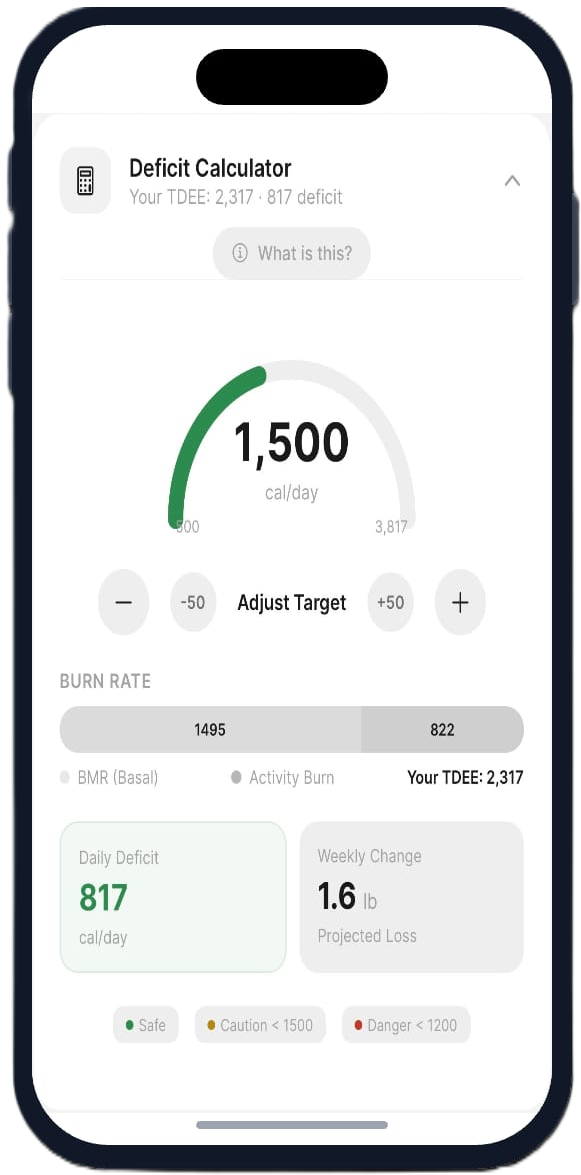


For most people, a deficit of 500 calories per day is ideal. This leads to approximately 1 pound of weight loss per week, which is a safe and sustainable rate. Smaller deficits (250 cal) are good for slow, steady progress while preserving muscle. Larger deficits (750-1,000 cal) can accelerate fat loss but are harder to maintain and may lead to muscle loss.
One pound of body fat contains approximately 3,500 stored calories. To lose one pound per week, you need a total weekly deficit of 3,500 calories, which is 500 calories per day. However, actual weight loss can vary because you also lose some water weight and the calorie content of body tissue isn't perfectly uniform.
Yes, a 500-calorie deficit is widely considered safe and effective for most adults. It's the most commonly recommended deficit by registered dietitians and health organizations. However, your total calorie intake should generally not drop below 1,200 calories per day for women or 1,500 calories per day for men without medical supervision.
Most health experts recommend losing 1-2 pounds per week. Faster weight loss is possible in the short term (especially for people with higher body fat), but it's typically not sustainable and can lead to muscle loss, nutrient deficiencies, and metabolic adaptation. Slow and steady weight loss leads to better long-term outcomes.
While it's possible to lose weight without tracking, research consistently shows that people who track their food intake lose more weight and are more likely to keep it off. Tracking provides awareness of portion sizes, hidden calories, and eating patterns that are otherwise easy to miss. Tools like CalTrax make tracking fast and effortless with AI photo recognition.
Tracking calories alone can drive weight loss, but tracking macros (protein, carbs, and fat) produces better results. Adequate protein intake preserves muscle mass, keeps you full, and supports recovery. A balanced macro ratio also helps maintain energy levels and prevents the loss of lean tissue that often comes with calorie-only approaches.
TDEE stands for Total Daily Energy Expenditure — the total number of calories your body burns in a day, including your base metabolism (BMR), physical activity, exercise, and the thermic effect of food. Your TDEE is your maintenance calories. Eating below your TDEE creates a calorie deficit, and eating above it causes weight gain. Knowing your TDEE is essential for any weight management plan.
BMR (Basal Metabolic Rate) is the calories your body burns at complete rest — just to keep your organs functioning, blood circulating, and lungs breathing. TDEE (Total Daily Energy Expenditure) includes your BMR plus all the calories burned through physical activity, exercise, and digesting food. TDEE is always higher than BMR.
Generally, no — at least not all of them. Fitness trackers and cardio machines tend to overestimate calories burned by 20-40%. If you eat back all reported exercise calories, you may unintentionally eliminate your deficit. A safer approach is to eat back about half of your estimated exercise calories, or better yet, keep your calorie target fixed and let exercise be a bonus.
Track your weight over 2-3 weeks (daily or weekly weigh-ins). Weight fluctuates day to day due to water, sodium, and digestion, so look at the trend, not individual readings. If you're consistently losing 0.5-1.5 lbs per week, your deficit is working. If not, you may need to re-evaluate your calorie tracking accuracy or adjust your target.
The most common reason is inaccurate tracking — underestimating portions, not counting cooking oils, or forgetting snacks and drinks. Other factors include metabolic adaptation (your body burns fewer calories after prolonged dieting), water retention masking fat loss, stress, poor sleep, and hormonal factors. Recalculate your TDEE, tighten your tracking, and give it 2-3 more weeks before making further adjustments.
This calculator uses the Mifflin-St Jeor equation, the gold standard for BMR estimation recommended by the Academy of Nutrition and Dietetics. It is the most accurate predictive formula available, but all calculators provide estimates — individual metabolism can vary by ±10-15%. Use the result as a starting point, track your food and weight for 2-3 weeks, then adjust based on real-world results.